The couch took some of my basement wall on the way out. I built the planner nobody sold me
Every room planner ever built answers does it fit in the room. Elbow Room answers the question that costs people money and plaster: can it even get there. Predicted two real outcomes at my own house that had already happened (a couch that did not fit, a 279 litre water heater that did), agrees to 1.63 x 10^-6 inches with a 300-year-old closed-form corner solve, and ships 19 WebMCP tools so an agent can operate the canvas by talking. Cross-origin bonus: a separate furniture shop can ask my staircase over a shared read-only tool, both sides consent by name.

The problem, on my own staircase
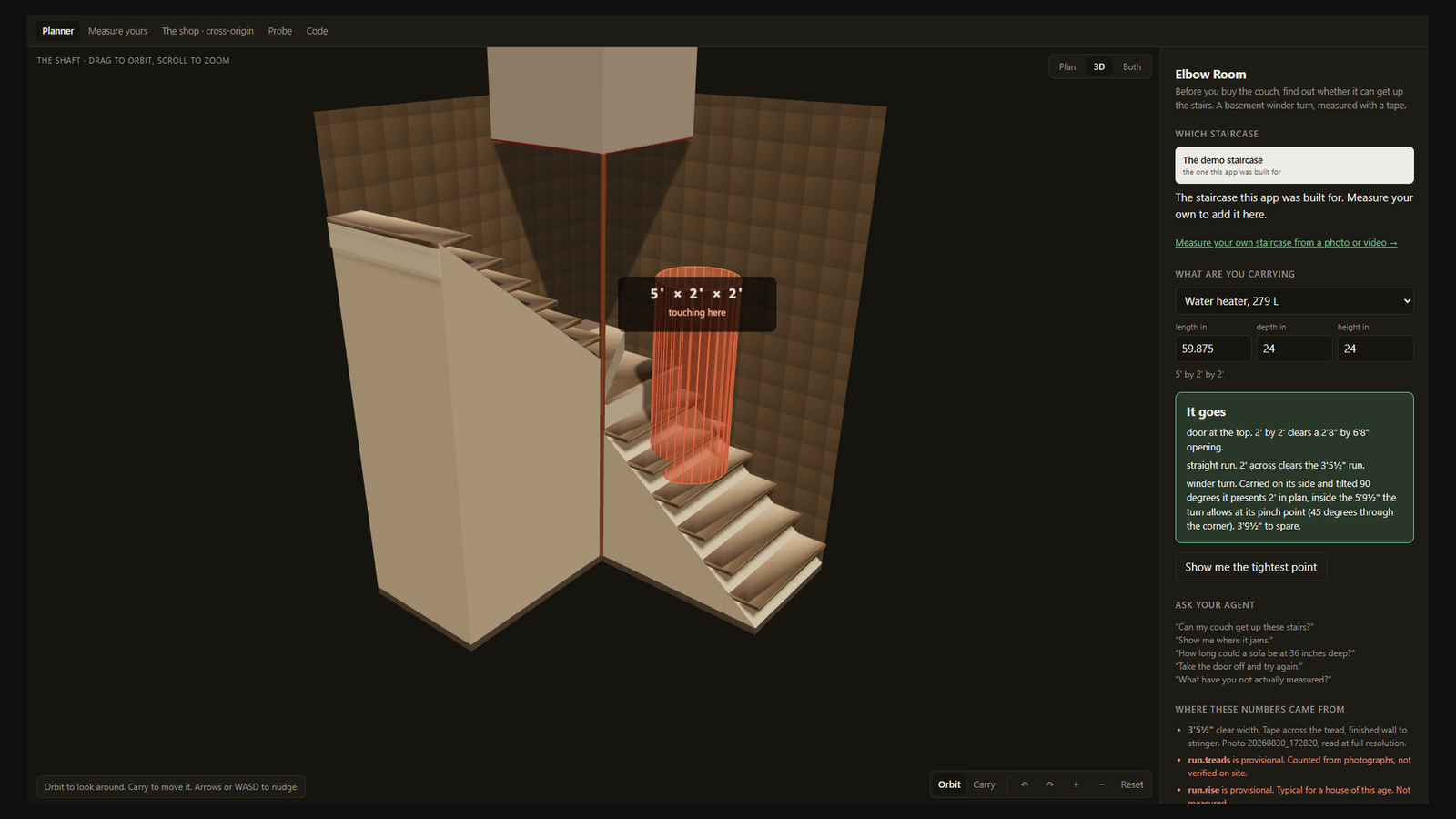
A couch got stuck in the basement stairs. It stopped dead at the turn and would not go round whichever way I tipped it. It came out in the end, and it took some of the wall with it. Then it happened to someone else. A flood forced a water-heater replacement and the installers brought a 279 litre tank down the same stairs without putting anything on the walls first. The gouges along the soffit edge are theirs, not the couch's. Two objects, one staircase, nobody measured it either time, and there was nowhere to look it up. The property listing gives all thirteen rooms to the inch and says nothing about the stairs. The one measurement that decides whether your furniture can get in appears on no listing, no floor plan and no product page.
Does it work, and who says so
Three claims, none of them graded by me. First, it predicted two real outcomes, both of which had already happened. The staircase has history that predates this software. The couch is 91 by 36 inches on a tape. The water heater is a Giant 172E-3F8M, 24 in diameter by 59 7/8 tall, from the manufacturer's engineering sheet rather than from my measuring. Predicted the couch does not go: it did not, the wall took the damage. Predicted the tank goes: it went, the soffit took the damage. n=2, stated plainly, and two more than an assertion.
The math nobody has to trust me on
Second claim: the corner solver agrees with a result three hundred years older than it. The longest thin rod that turns a right-angle corner between corridors of width a and b is (a^(2/3) + b^(2/3))^(3/2), a closed form in any calculus textbook. Elbow Room does not use that formula. It minimises a/sin t + b/cos t - w/(sin t x cos t) numerically because a couch has width and a rod does not. Set width to zero and the two must agree. Across 169 width pairs from 24 to 60 inches they disagree by at most 1.63 x 10^-6 inches, and on the real staircase they agree to machine precision. eval/closed_form.mjs, one command, no key. A judge can check the formula in thirty seconds and does not have to trust a line of my code.
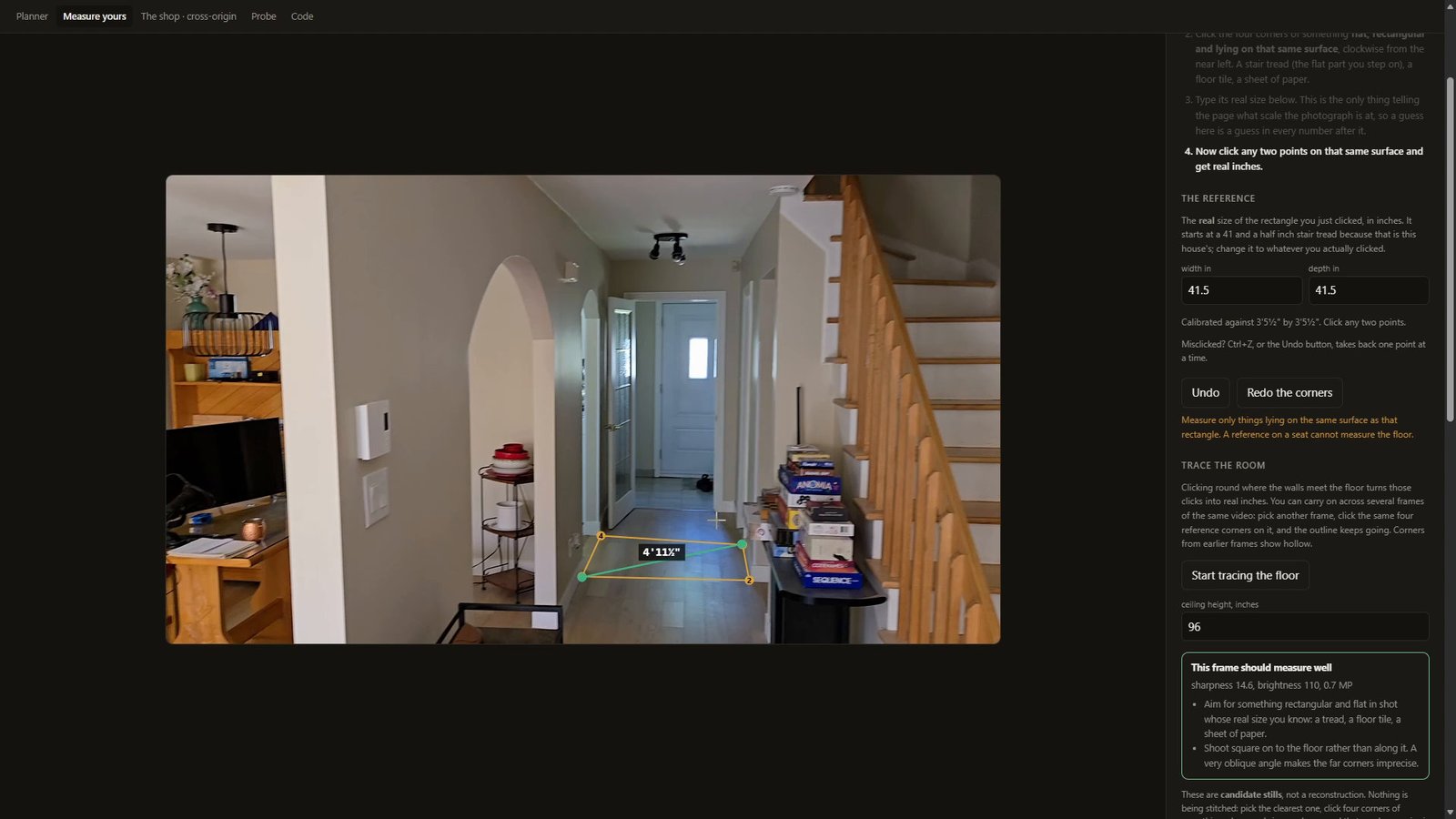
Third: the photograph-to-inches maths is checked against a camera it never saw. Four clicked correspondences determine a homography between the image and the floor plane. Verified against a synthetic camera with genuine perspective, distances the calibration never saw come back within four thousandths of an inch. That is what makes the /measure/ page real inches instead of a guessed pixel scale.
Why WebMCP was the right shape
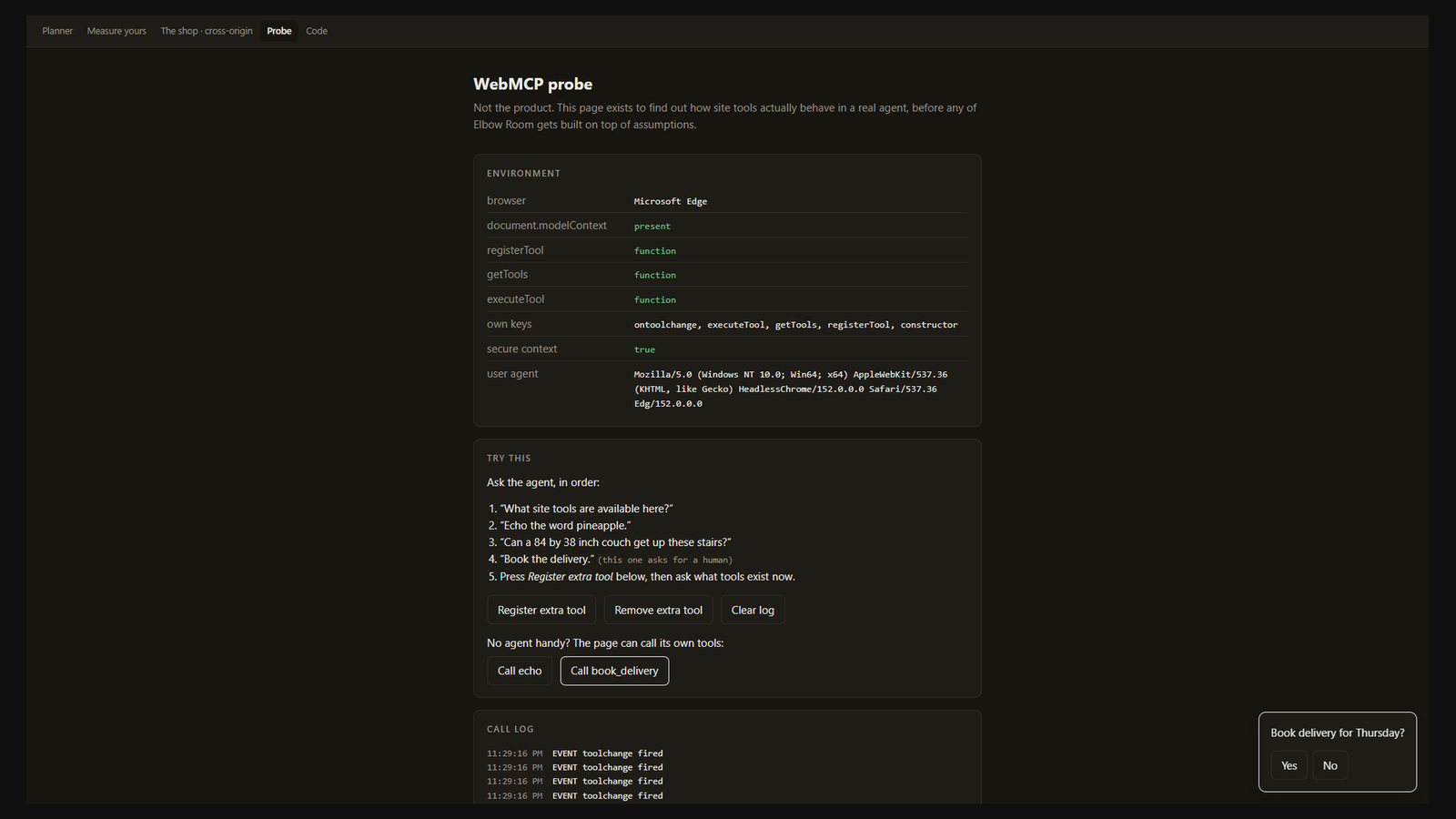
The interesting state lives in a <canvas>, and a canvas is invisible to an agent. There are no elements to read and nothing to click. That is not a claim, it is measured, headless and without an API key, in eval/interface_comparison.py. The first result corrected me. Reading the state already on screen, the accessibility tree answered 7 of 8 questions, because the sidebar renders the verdict as text. The canvas is invisible, the page is not. That table ships exactly as it came out.
The sharper question is asking something the page is not displaying, or changing it. There a DOM-driving agent has a control for only 3 of 7 tasks, against 7 of 7 through site tools. The distinction is not read versus read: the DOM exposes one frozen state, the tools expose the function. An agent can read that this couch fails. Without tools it cannot ask what would fit, cannot retry with the door off, cannot place the object at a coordinate, and cannot hand a measurement back for a human to approve.
A separate furniture shop asks your staircase
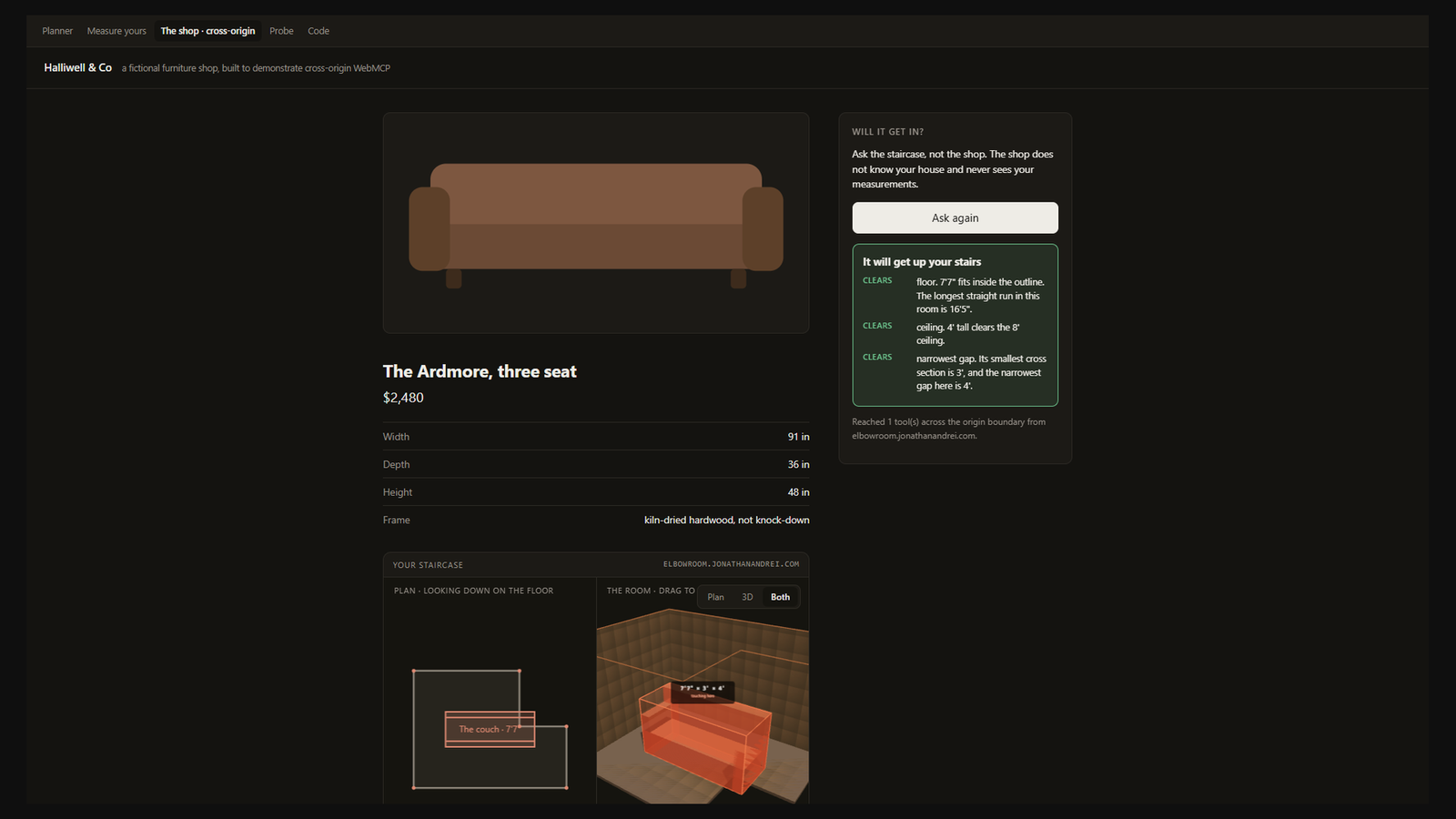
halliwell-and-co.vercel.app is a separate origin selling a sofa. It embeds the planner and calls check_fit across the boundary. Consent is mutual: the tool names the shop in exposedTo, the shop names the tool's origin in fromOrigins, and the browser refuses registration in a cross-origin frame without allow="tools". Any one withheld and nothing happens. Exactly one tool is shared, and it is read-only. The shop gets a yes or no about a sofa whose dimensions it already published; it never learns your measurements, never sees the plan and cannot move anything. That is the part of this spec that is actually about the open web: two sites with no API between them, no SDK, no shared account, cooperating because both said yes.
What the tank taught it
The water heater cleared the turn with 3 ft 9 1/2 in to spare and still gouged the wall going down. So fitting, and fitting without touching anything, became two different answers. The 3D view colours the object by whether it is touching, not by whether it fits, because of that afternoon. Honest limitations: rigid bodies only, so a mattress bends and its verdict is a lower bound. Headroom over the turn is estimated rather than measured, and eval/headroom_sensitivity.mjs sweeps every plausible value to show the verdict never moves. The ground truth for the real-world predictions is two objects. n=2, stated as n=2.
Elbow Room: before you buy the couch, find out whether it can get up the stairs
View the project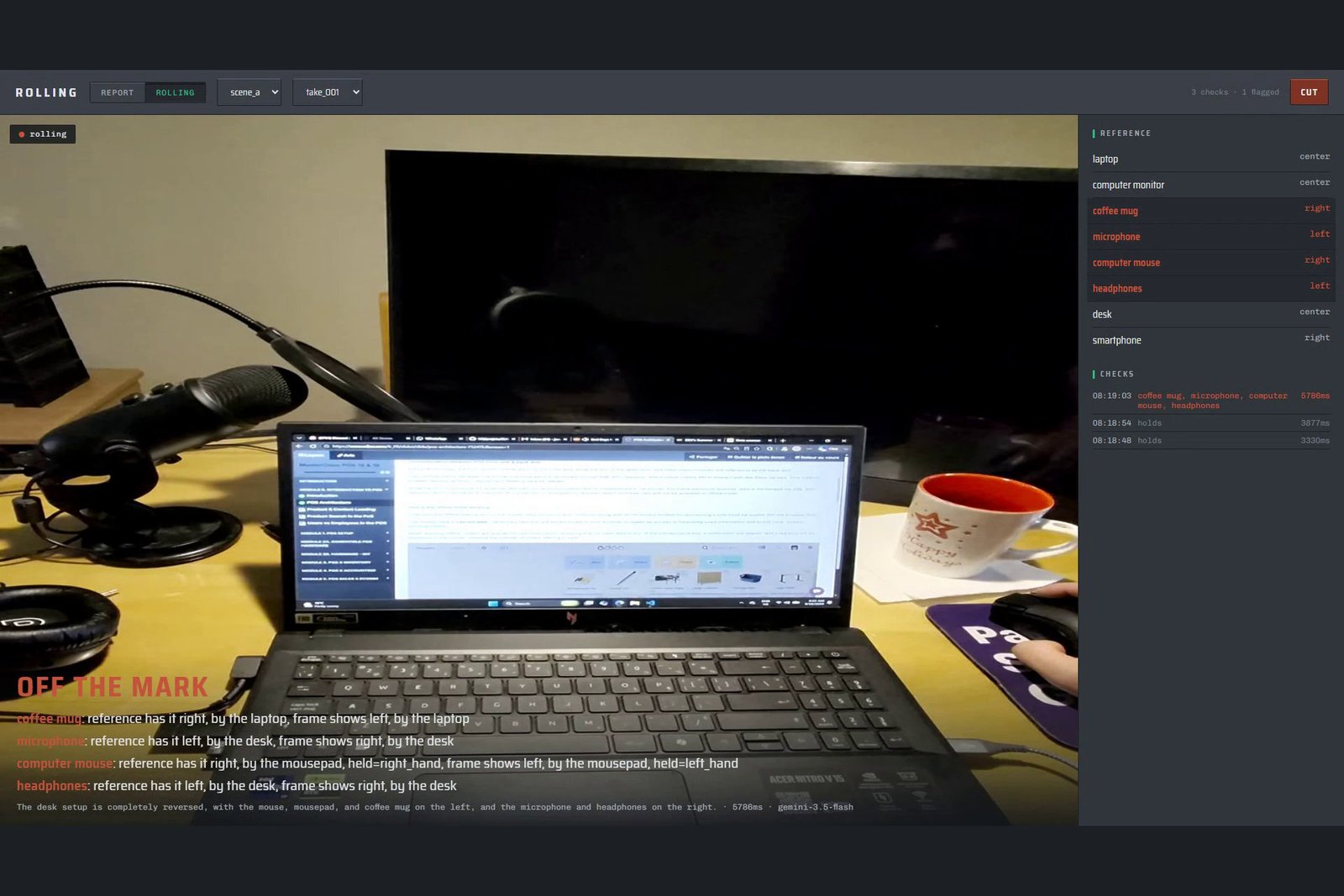
A camera assistant wears smart glasses through a shoot and walks off set with the continuity paperwork already written
The last job on a film shoot still done entirely on paper is continuity. Miss a line, find out at the edit, pay for a pickup day at $1,440 to $3,020 (Giggster 2026). Dailies watches a take through Ray-Ban Meta Gen 2 glasses for 1.6 cents at Google's published Gemini rates, 63 cents a forty-take day, 0.04% of the day it is guarding. Gemini reads every take, ClickHouse Cloud holds the observations, and a plain-English question box lets an agent write its own SQL through the official mcp-clickhouse server. The agent cannot destroy data: three independent layers, and the one that matters is a readonly cluster credential refusing DROP, INSERT, TRUNCATE, CREATE TABLE and ALTER with ClickHouse code 497. Median rolling verdict is 4.4 seconds, spoken back into the wearer's ear. The catch in the 2 min 31 s demo lands at 0:49.
I just published my first Udemy course: the ServiceNow catalog build I've done twenty times, plus the Now Assist Skill Kit end to end
Two years on the ServiceNow team at Cirque du Soleil, plus a stretch on client work at N2, taught me which parts of the catalog + Flow Designer + Now Assist stack you actually reach for and which parts the docs make you think matter but don't. The course is that filter, recorded from scratch on a fresh instance, ending with a Now Assist Skill Kit publish flow that isn't in the docs yet. Launch coupon inside.