An insurer upholds its own denial two times in three. An independent doctor overturns it three times in four. Day Thirty is the appeal nobody files
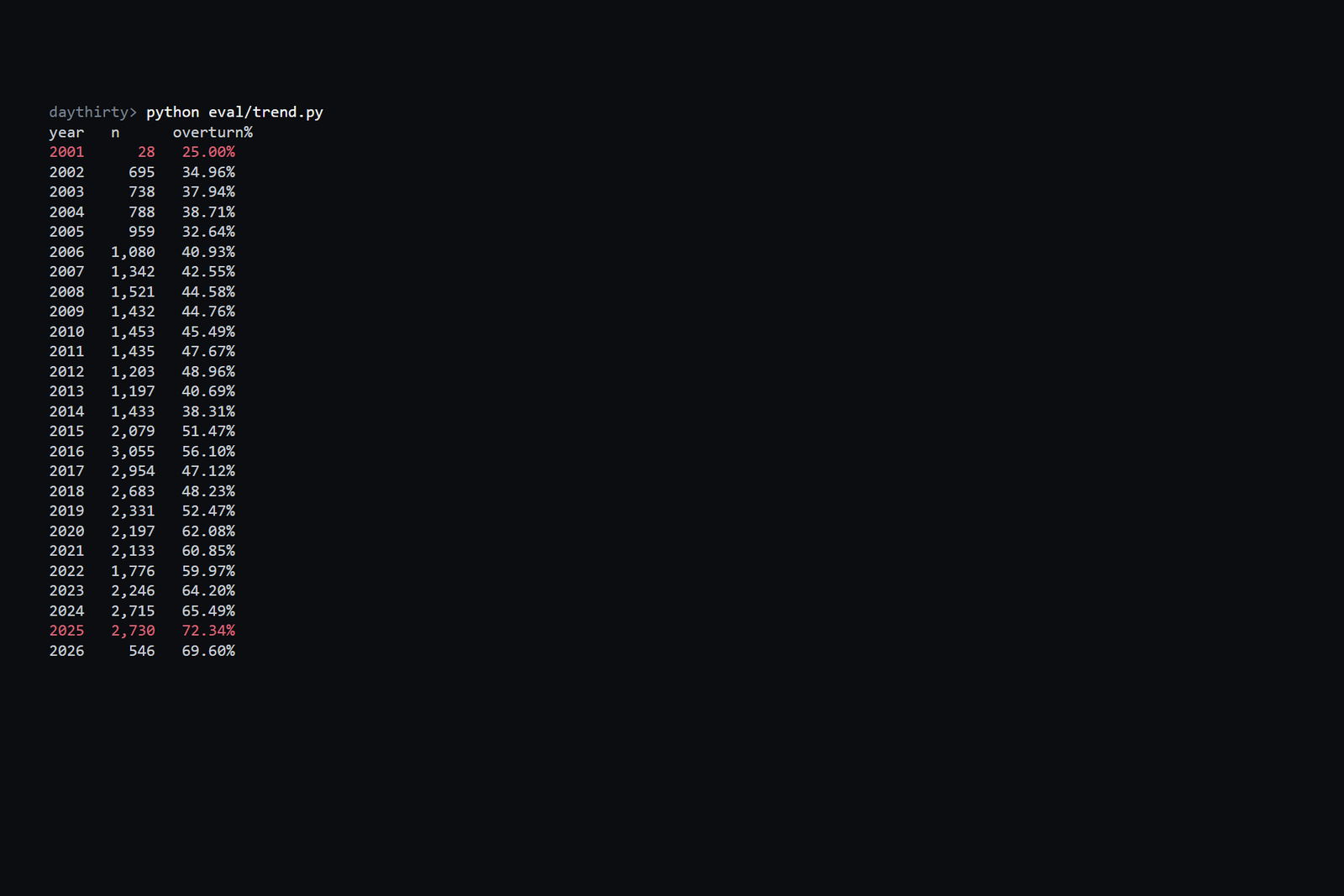
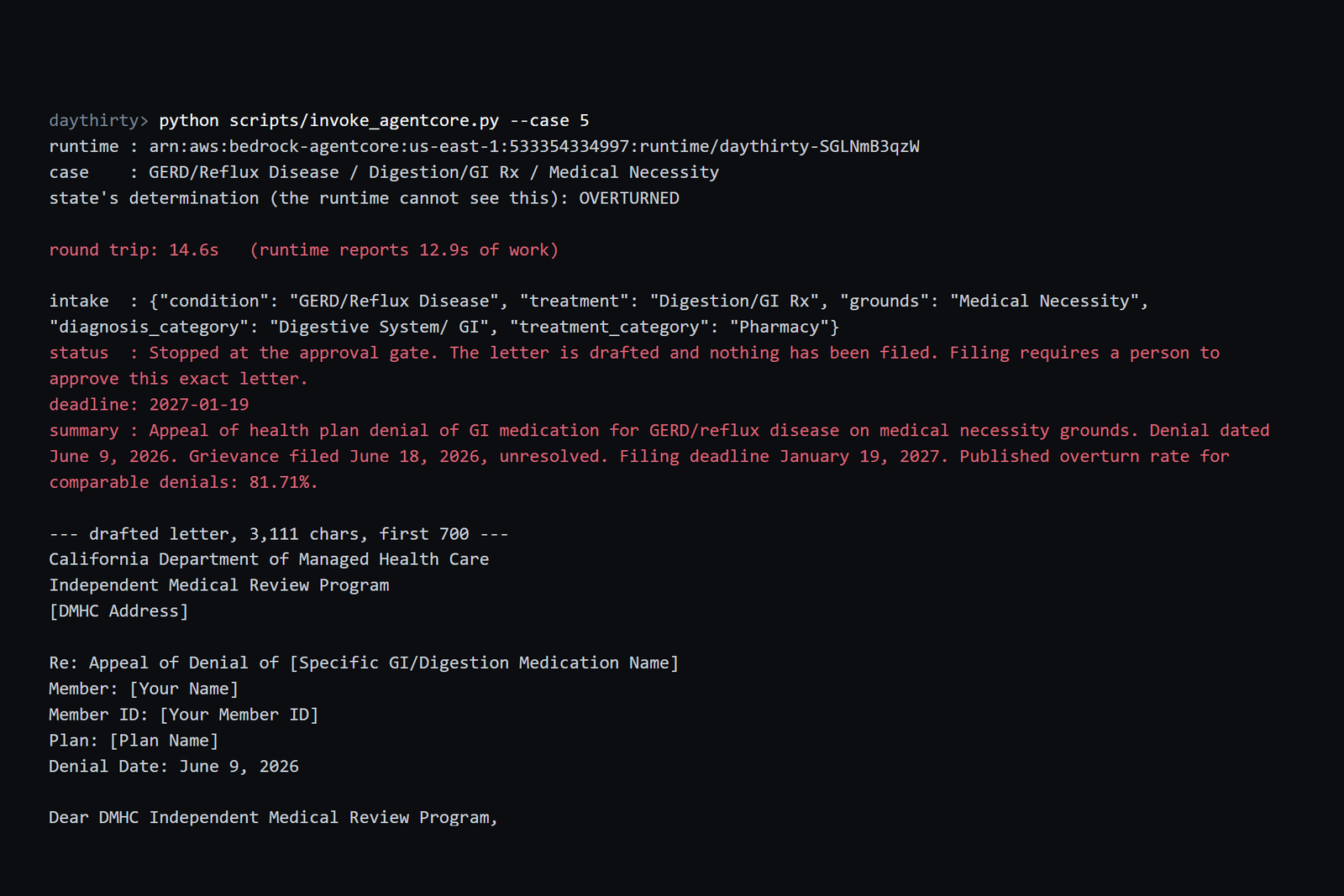
Insurers upheld 66 percent of appeals they received in 2024 (KFF). California's Independent Medical Review overturned 72.3 percent of the denials that reached an independent physician in 2025. Under one percent of denials get appealed at all, partly because of a clock nobody explains: thirty days after you file a grievance, whether or not the plan has answered, a six-month deadline starts. Day Thirty reads the denial with Nova, computes the deadline from the statute with every provision cited, pulls how California actually decided 22,090 comparable cases, drafts the appeal with Haiku 4.5, and stops at a Strands interrupt for your signature. 15.1 seconds median to a drafted appeal at the gate. Every number graded by the state's own record.
I also wrote a longer walkthrough of the build on AWS Builder Center, with more on the Strands interrupt and the AgentCore deployment:

The entire gap is people not filing
Last year insurers denied about 85 million in-network claims on HealthCare.gov. Consumers appealed 262,982 of them, under one percent, and insurers upheld 66 percent of the appeals they received (KFF, 2024). When the same kind of denial reaches an independent physician through California's Independent Medical Review, 72.3 percent were overturned in 2025. An insurer reviewing its own denial upholds it two times in three. An independent doctor overturns it nearly three times in four. The people who would win are, overwhelmingly, the people who never file.
The clock nobody tells you about
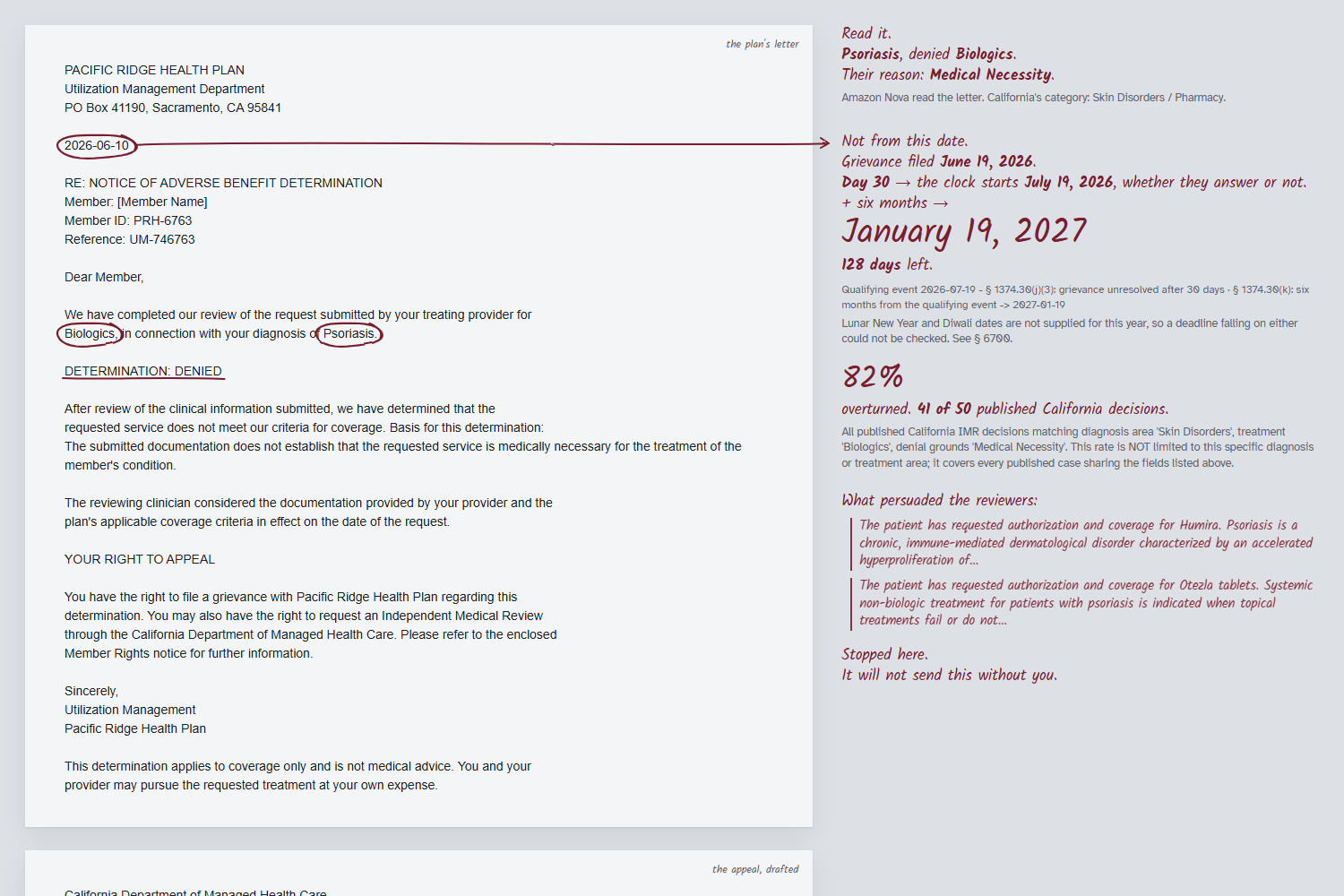
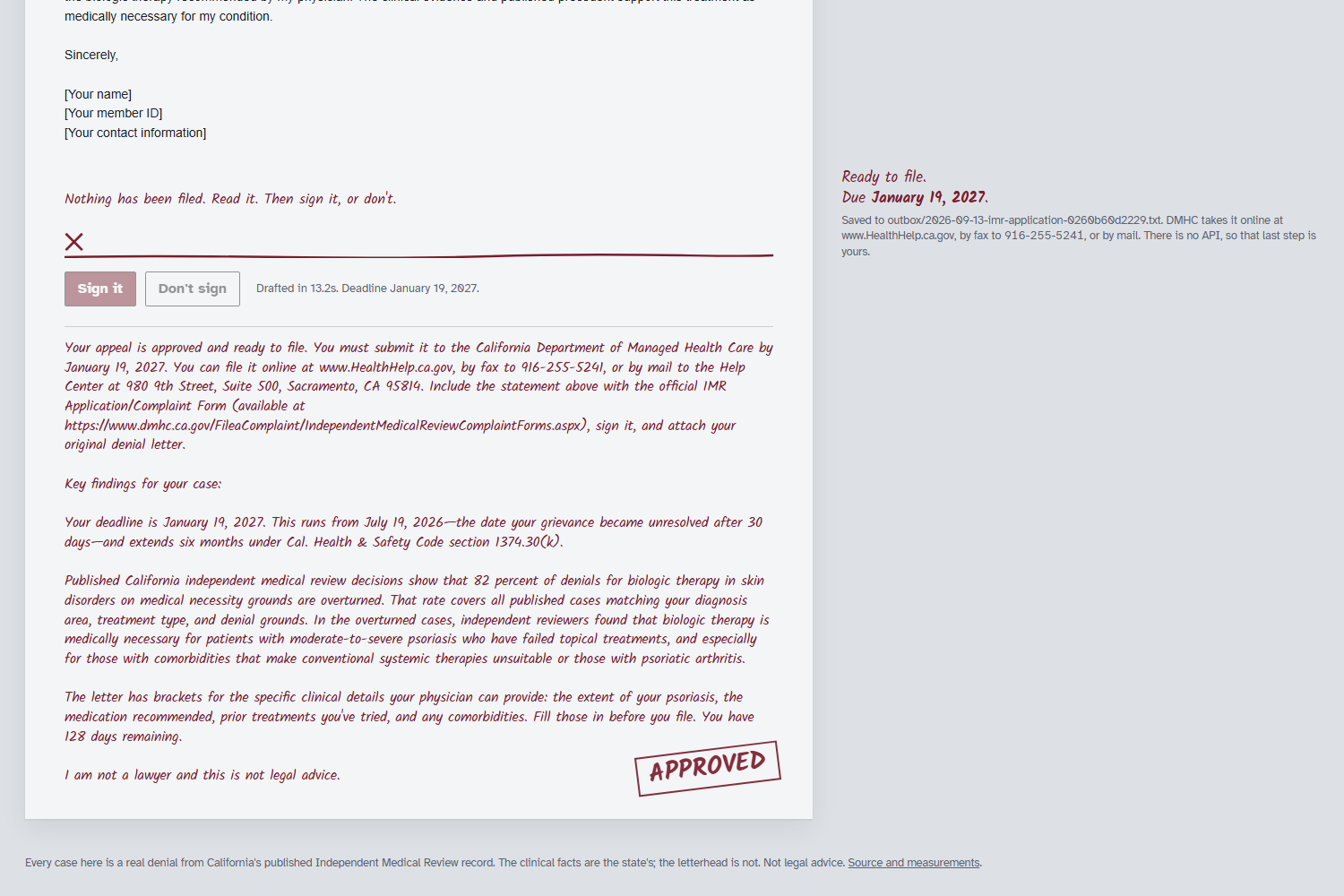
Part of why people do not file is a deadline that starts earlier than anyone expects. Under Cal. Health and Safety Code 1374.30(j)(3), an enrollee shall not be required to participate in the plan's grievance process for more than 30 days. So thirty days after you file a grievance, whether or not your plan has answered, a six-month clock starts under 1374.30(k). If the plan takes four months to say no and you count six months from the no, you are already three months late. That is where the name comes from, and it is the one part of the product no model is allowed to touch. The deadline is computed in code, and every rule cites its provision: HSC 1374.30(k) and (j)(3), Civil Code 14, 10 and 7 for how days are counted, Government Code 6700 for holidays. A hallucinated deadline is the one error that cannot be recovered from.
Argued from what actually persuaded the reviewers
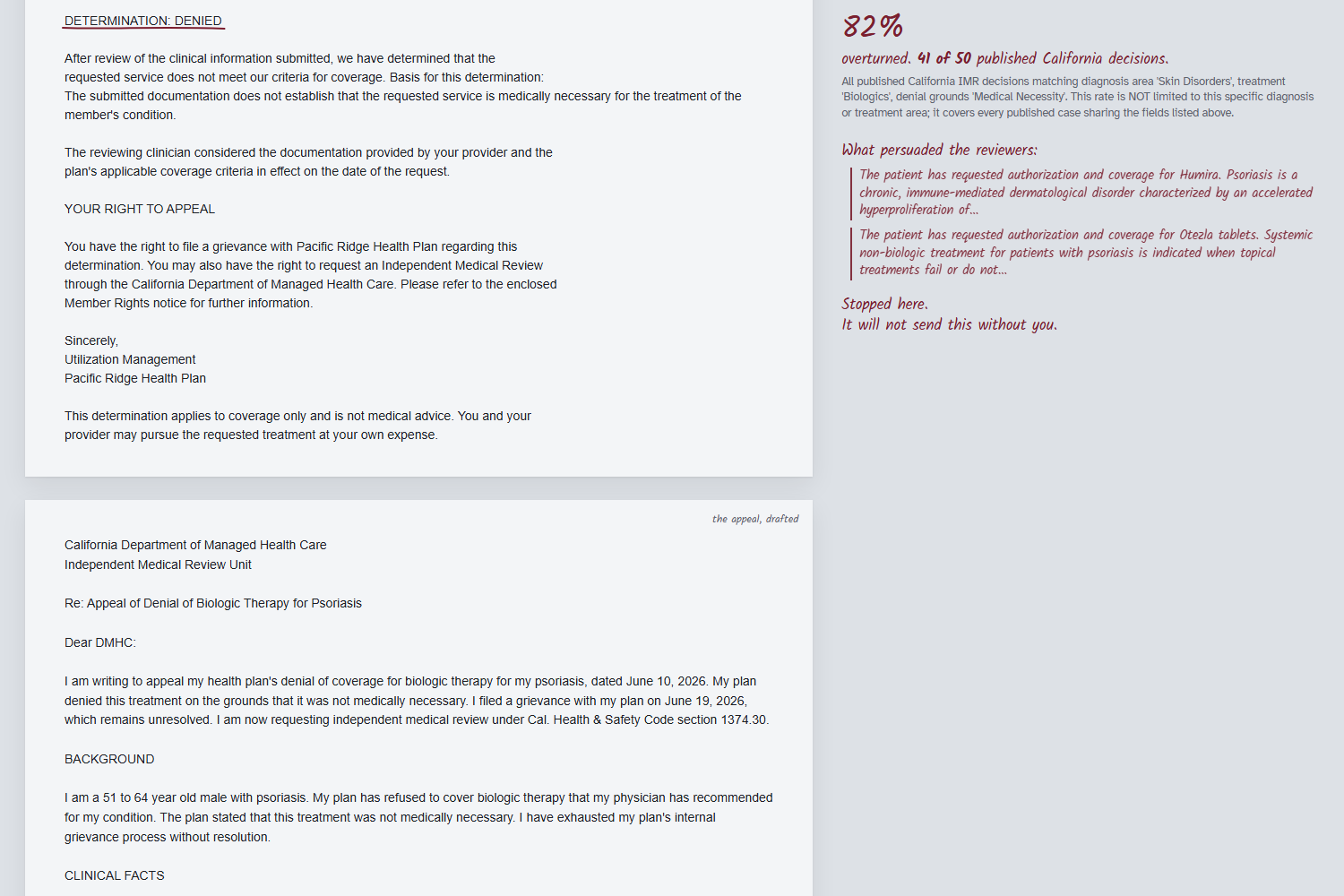
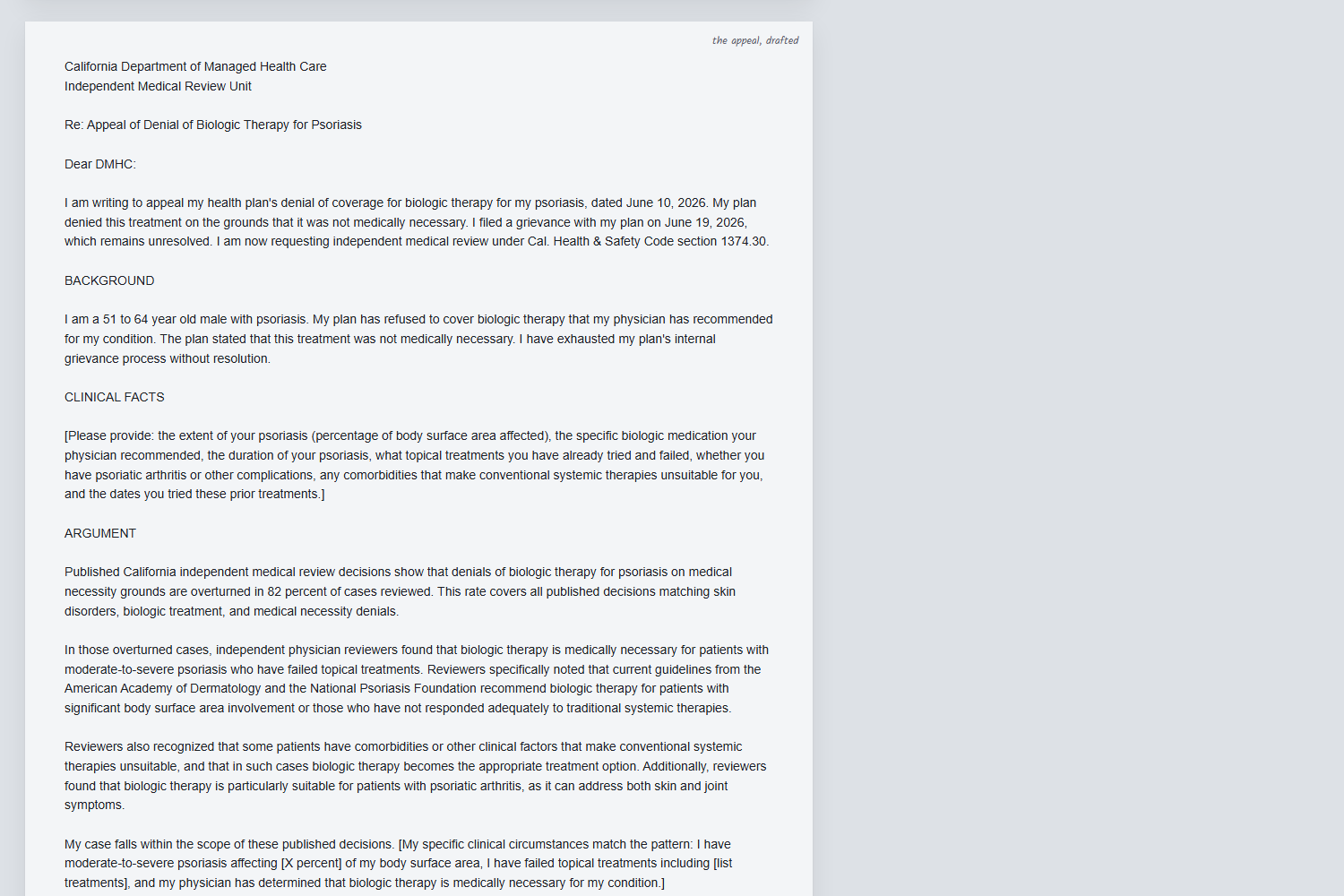
The corpus is public data from California's Department of Managed Health Care: 42,749 published determinations from 2001 to 2026, fetched by script. Each one was made by a state-contracted physician reviewer, with the reasoning attached. Splits are temporal and leak-controlled. Precedent comes only from 2016 to 2024, 22,090 cases. The 3,276 held-out cases are 2025 to 2026, with the reviewer's narrative stripped because it states the verdict. For a new denial, Day Thirty retrieves how the state actually decided comparable ones, reports the published overturn rate for that cohort with its exact scope, and surfaces what the reviewers found persuasive in the cases that won. Then Claude Haiku 4.5 on Bedrock drafts the appeal, arguing only from those findings.
Then it stops
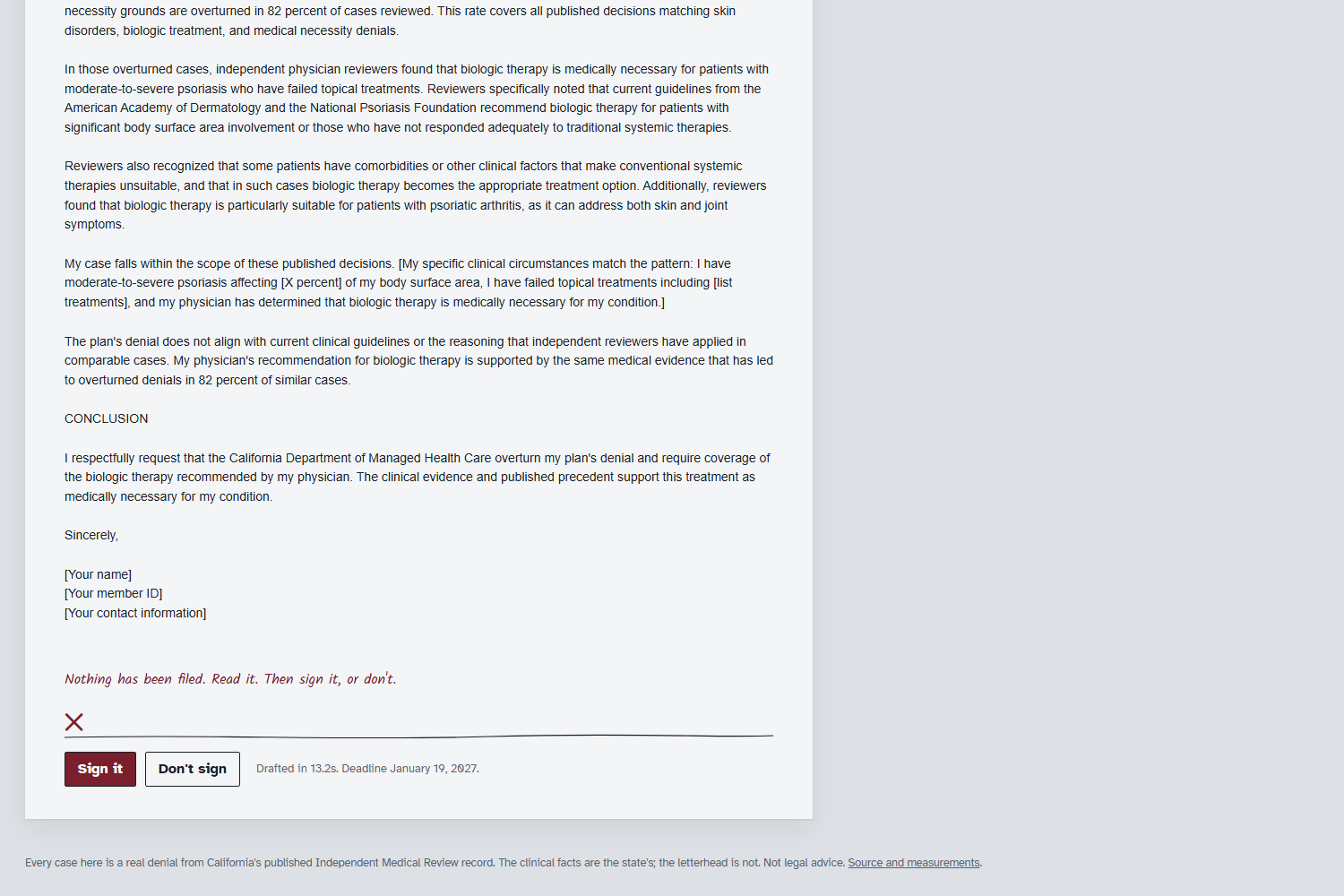
A Strands interrupt hands the exact letter to a person. The run returns with the letter in result.interrupts, the person decides, and the run resumes with their answer. Nothing is filed without approval, and nothing is filed by the software after it either. DMHC publishes no API for IMR applications, so approval produces the finished application with the due date and DMHC's real channels (online, fax, mail), and the person sends it. The page used to stamp FILED after approval when nothing had been submitted. I caught it before recording the demo and fixed the product rather than the wording: the page now says that last step is yours, and the tagline says ready to sign instead of filed, because a sentence must never be more real than the artifact behind it.
What the ablation showed
Same model, same six real denials, one tool switched off at a time. Without California's record, the model invented overturn rates of 40, 50 and 60 percent in half the letters, with nothing to cite. With it, 12 of 12 rate claims trace to the state's published figure. Without the statute engine, on the timeline where the plan sat on the grievance for 120 days, the model counted six months from the plan's answer and landed 86 days late in 5 of 6 cases. That is the appeal forfeited. It was told the rule in words and still did not apply it. Anything where a wrong answer cannot be recovered from belongs in code that cites its provision, and the model should be handed the result.
The boundary between model and lookup turned out to be an empirical question, not a design taste. Asking Nova for California's category directly scored 30 percent. Reading the misses showed the state files Speech Therapy under Autism Related Treatment and Arthritis under Immuno Disorders, classifying by patient context a letter does not contain. That is not inference, it is a lookup, so the boundary moved: the model reads, the state's own filings classify. Diagnosis went from 30.0 to 66.7 percent and treatment from 33.3 to 83.3 percent.
What is not claimed
No prediction of your outcome. That was the original headline and it was dead on day one: the held-out overturn base rate is 71.89 percent and precedent lookup scores 0.7234, a lift of +0.005 over a constant. The published rate for a matched cohort runs from 5.0 to 98.6 percent, and telling someone that number, with its exact scope, is worth more than a guess dressed as a forecast. The product is a reporter, not a predictor. The astronomical holidays in Government Code 6700 (Lunar New Year, Diwali) are supplied as data and the tables are empty; every result says so. A Nova embeddings index for the 15.9 percent of denials with no close taxonomy match was built and abandoned on throttling; the script stays and the README says the index is not built. And the software does not file. Every number in the README is held to the reports on disk by eval/check_claims.py under pytest, which found seven disagreements on its first run, two of them real, and now audits the gallery captions too.
Day Thirty: your insurance appeal, argued from 22,090 decisions California's own physicians published, ready to sign before the day-thirty clock runs out
View the project
Sixteen real calls to pharmacies, zero prices, and the measured reason why: the agent talks over the pharmacist
Pharmacies paid about 43 cents for thirty metformin, a number CMS publishes weekly from invoices. What you pay is different at every counter and published nowhere, so the only way to learn it is to phone. Sticker gives a CALL-E phone agent a drug and a ZIP, reads the federal NPI registry, calls the pharmacies you authorize, and joins every quoted price to CMS NADAC. Sixteen real calls in one Manhattan ZIP produced zero prices and zero refusals. The platform's own event stream showed why: 24 collisions across 15 traced calls where the agent opened its turn while the pharmacist was still speaking. Filed upstream as issue #415, picked up by a maintainer the same day. The contribution merged as PR #404 after five review passes. Zero is a result if you say how you got it.

Your Canadian truck already drove that lane empty. Northbound finds the freight it could legally have carried
10,479 completed legs, 1,596,093 miles, two months of Roadstar Trucking's real dispatch data. Coming home empty happened six times. The real empty running is inside the United States, between loads, and whether it could have carried freight turns out to be a legal question, not a routing one. 19 CFR 123.14(c)(1) permits US point-to-point carriage when it is part of the return of the vehicle to its base country, so the verdict turns on which way the load runs. 217 legs, 66,702 miles, $155,815 at ATRI's 2025 industry cost, already travelling toward the border and legally able to carry. GLM 5.2 on SPUR reads the offer, a deterministic TypeScript engine cites the statute. Ablation on 100 real offers in five broker formats: 100 percent correct verdict with the model, 40 percent without.