Bloom: Nobody Cancels, They Just Stop Coming. Bloom Reads Each Client's Own Visit Rhythm, Flags the Ones Drifting from It, and Writes a Personal Note to Each. Rules Decide Who, Gemini Decides What to Say.
A typical salon loses about 40% of its clients every year, a first-timer who does not rebook within 30 days has about a one-in-five chance of ever returning, and a loyal regular is worth several hundred dollars a year. The signal is invisible because it is an absence, spread across hundreds of people who each have their own rhythm. Bloom's architecture is the idea: rules decide WHO (deterministic risk engine on each client's own median visit gap), Gemini decides WHAT TO SAY (a short note in the owner's voice, referencing that person's real history). The demo of the whole thesis is two clients: Aisha and Jane are both 44 days since their last visit; Aisha comes every 8 weeks, Jane comes every 4. Any tool that flags 'no visit in 60 days' is wrong about one of them.
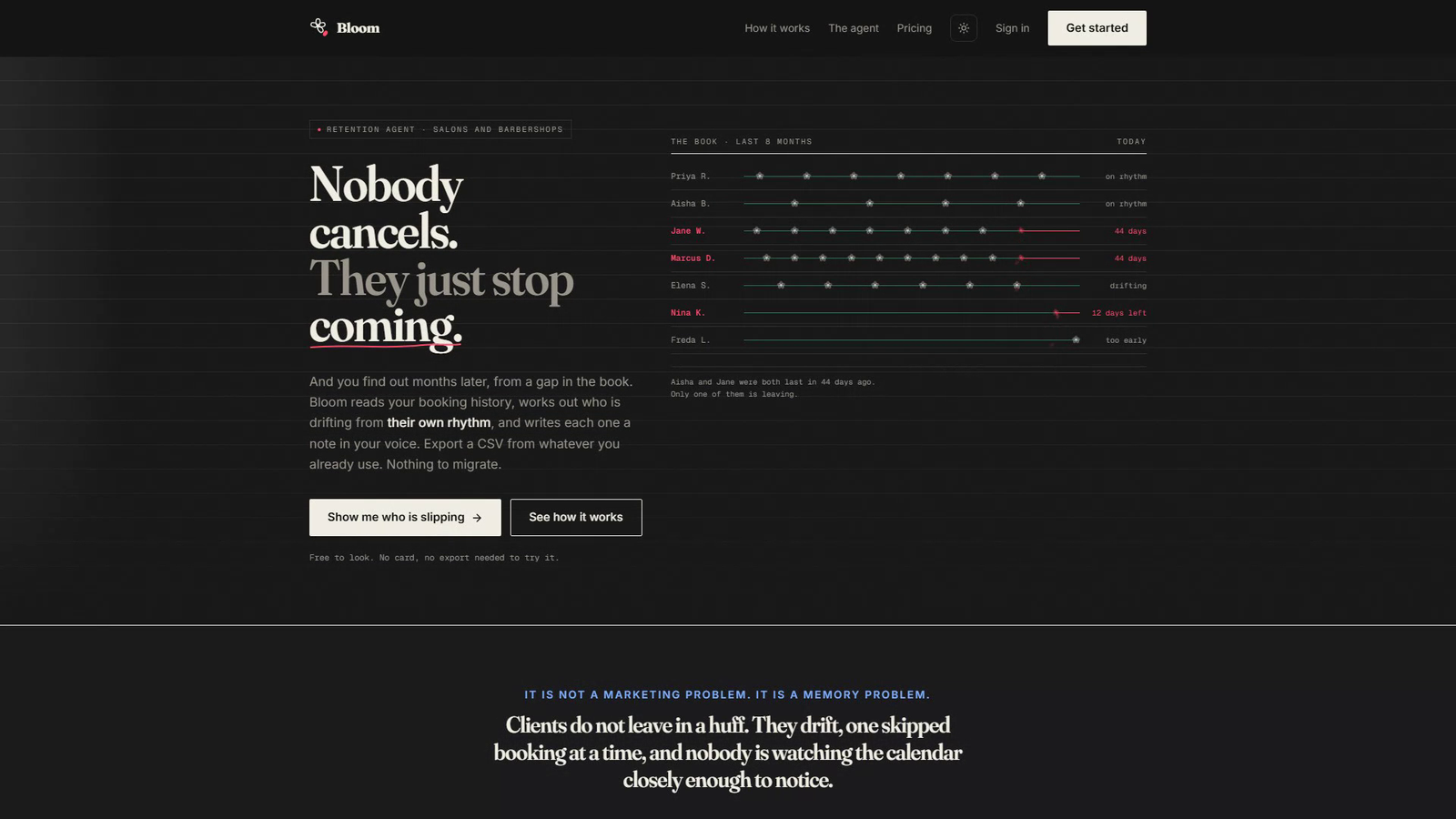
The architecture is the idea
Rules decide WHO. Gemini decides WHAT TO SAY. The risk engine is deterministic, and deliberately so. It computes the median gap between a client's real visits (median, not mean, because one six-month gap for an injury would drag a mean far enough to hide a real lapse), then scores them against their own cadence. It is exact, auditable, reproducible, and it never hallucinates: the same book always produces the same verdict, which matters when the output is 'this person is worth $1,295 a year and she is leaving.' Gemini then does what a rule cannot: reads one messy human history (what they last had done, how often they normally come, how far past their own rhythm they are) and writes them a short note in the owner's brand voice. The owner reviews, edits any line if they want, and approves before Bloom sends from the business's verified domain. Never a blast: one message, one person, once.
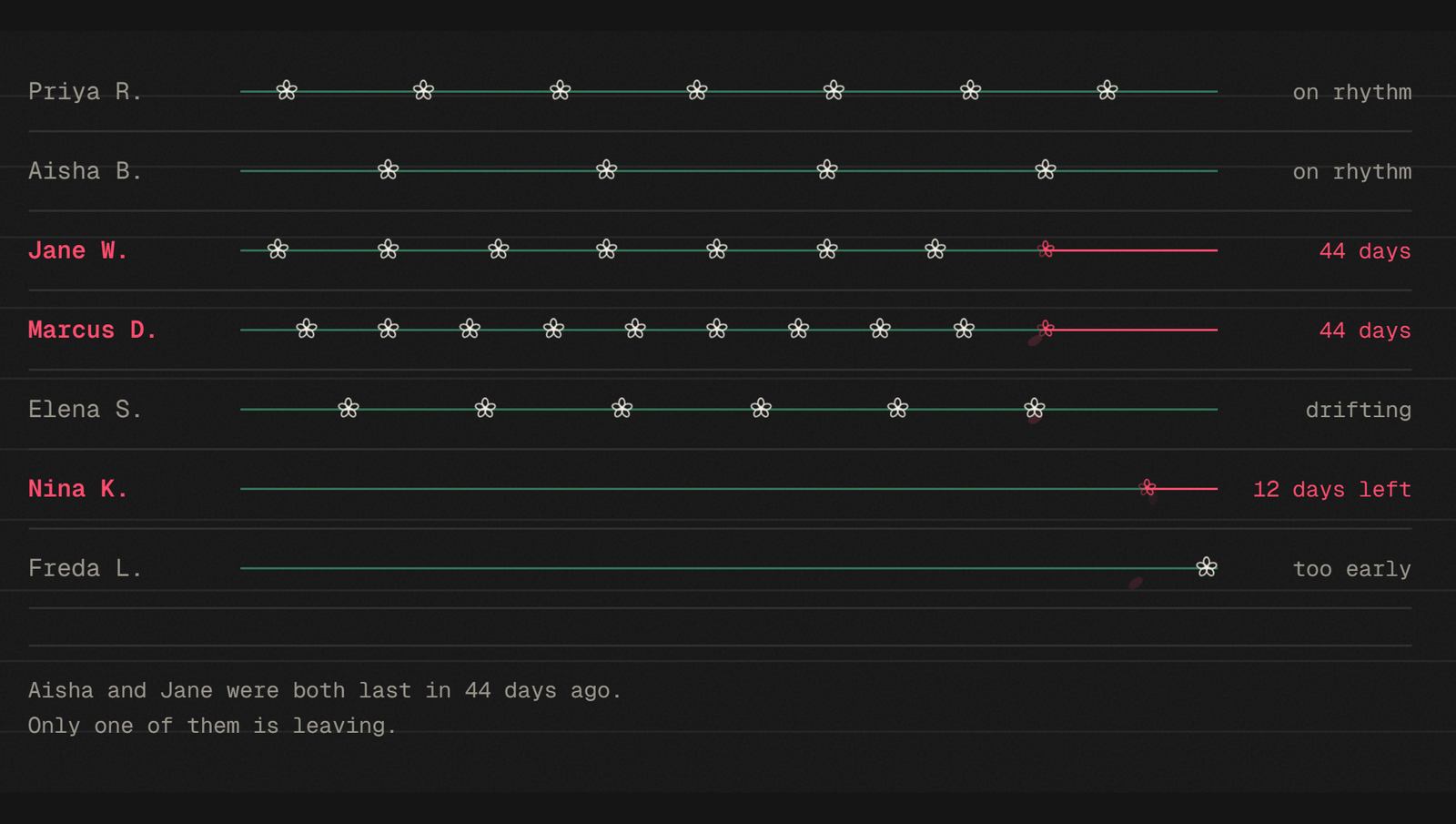
Nothing to migrate: whatever the owner already uses
The owner exports a CSV from whatever they already use (Fresha, Square, Vagaro, Booksy, even Google Calendar) and uploads it. Nothing to migrate, nothing to install. The parser finds the columns by keyword rather than by header name, so exports from platforms Bloom has never seen still work. Same-day rows are merged into one visit, because those platforms export a row per service line item. That part is free, because it costs nothing to show someone their own losses. What the owner sees is a client radar scoring every client against their own cadence, with what each is worth a year attached; from there, the owner triggers a win-back one client at a time. Delivery is capped per-business and globally, with atomic send-claim as the backstop so a replayed cron never doubles a message. The save is measured on the owner's own data: re-upload a fresh export, and if the client booked again after the note went out, Bloom counts it.
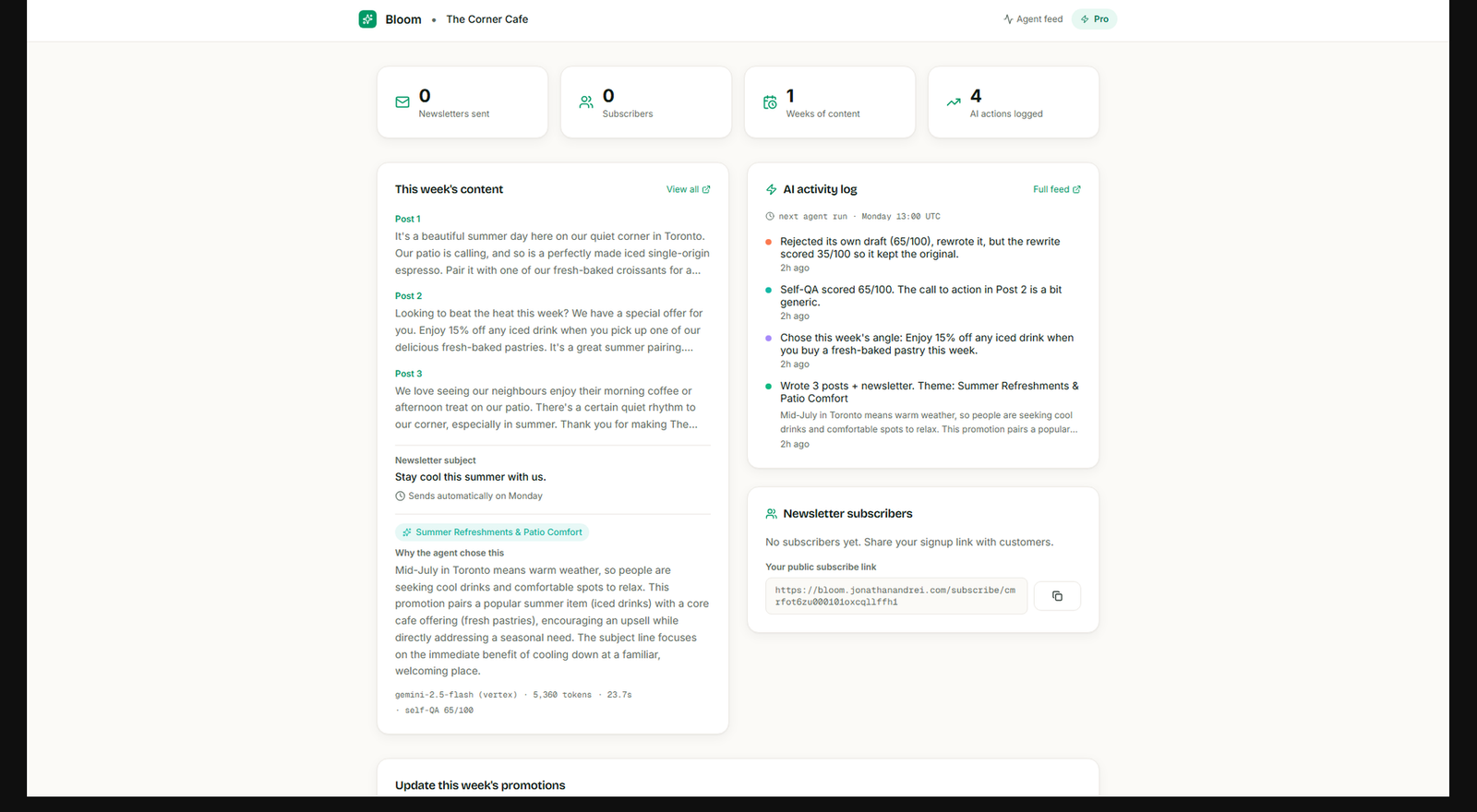
The autonomous weekly agent, still shipping
Bloom started as a marketing-content agent and pivoted to retention. The pivot happened because content is a commodity: any owner can get captions out of a chatbot in thirty seconds, and I was selling something free. What none of them could get was an answer to a harder question: which of my clients am I about to lose. That is where retention now lives. Separately, the original weekly content agent still runs fully autonomously on a cron sidecar. Every Monday it picks the week's angle, generates three social posts and a newsletter in the owner's brand voice, runs a self-QA gate that rejects and rewrites its own drafts if they score below a threshold, and on Pro sends the newsletter from the verified domain. Every action lands in a live public agent feed (`/agent`) that a judge (or anyone) can watch in real time. It is no longer the headline, but it is the reason AI-Native Operations, a third of this hackathon's score, is genuinely satisfied rather than performed.
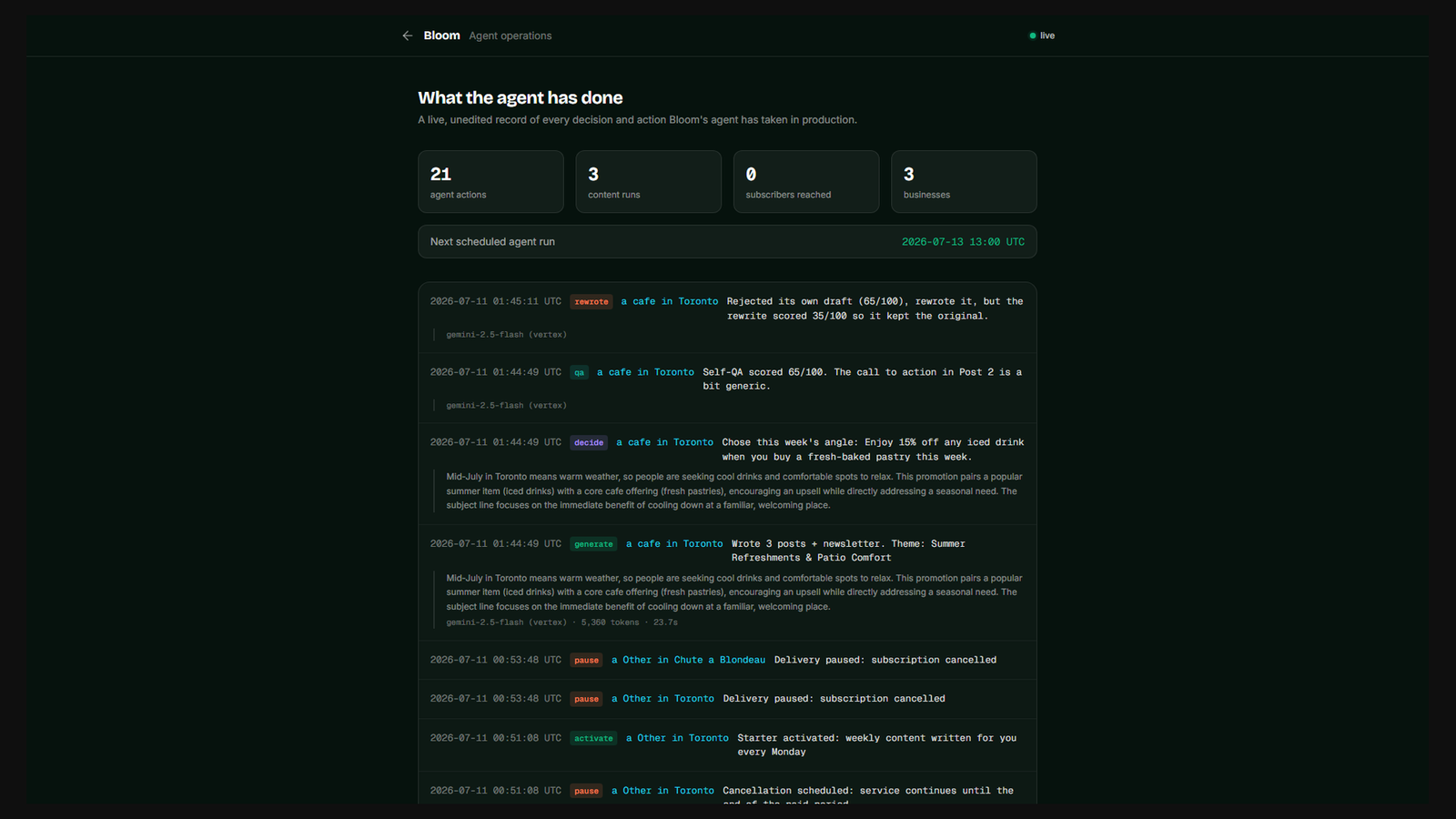
Bloom: Nobody Cancels, They Just Stop Coming. Bloom Reads Each Client's Own Visit Rhythm, Flags the Ones Drifting from It, and Writes a Personal Note to Each. Rules Decide Who, Gemini Decides What to Say.
View the project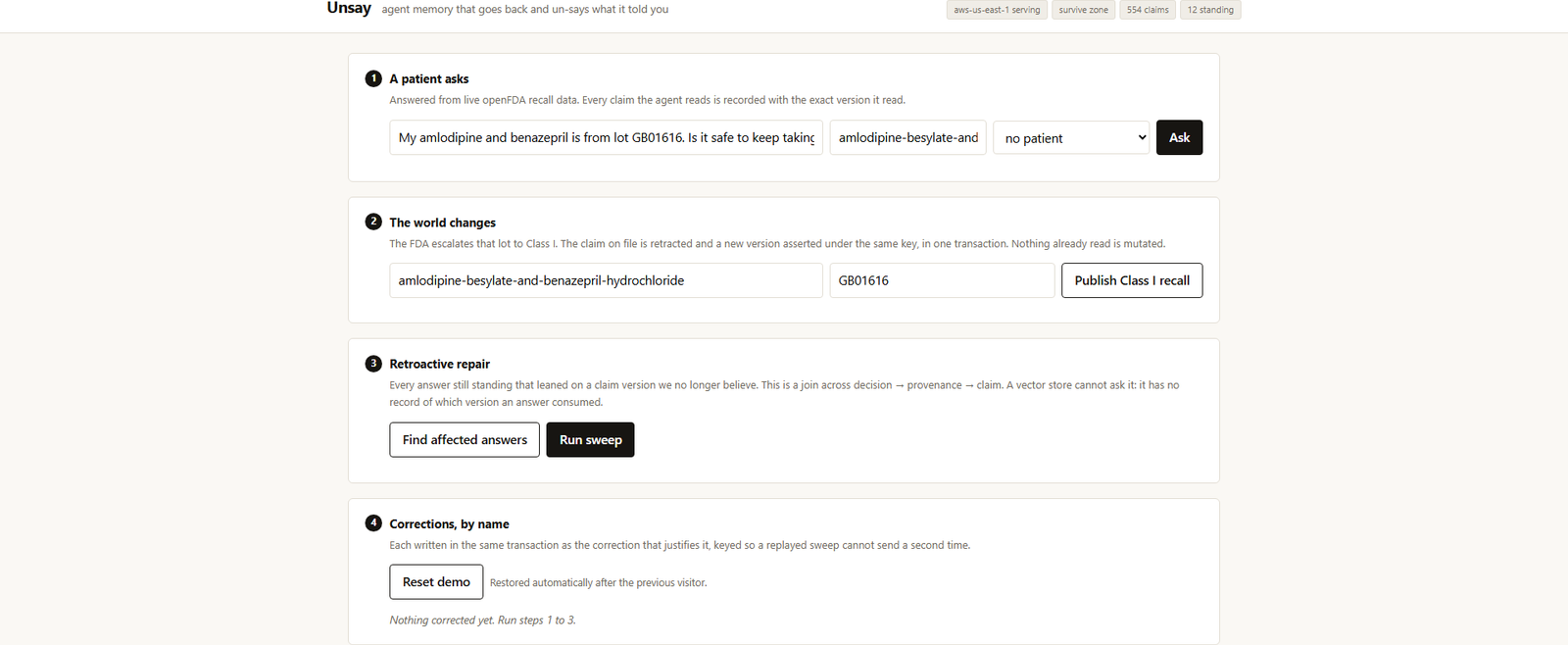
Unsay: An AI Medication-Safety Agent that Goes Back and Un-Says What It Told You. When the FDA Escalates a Recall, It Corrects Every Named Patient It Already Reassured, in Seconds.
Agent memory has a failure mode retrieval quality cannot fix: stale context. Similarity to a stored memory does not prove the memory is still true. For most agents that is embarrassing. In a pharmacy it is a Class I recall. Unsay's fix is a bitemporal schema on CockroachDB (`valid_from`/`valid_to` for the world, `asserted_at`/`retracted_at` for this system's belief), and a join no vector store can express: every answer still standing that leaned on a claim version we no longer believe. The replay still works past the AS OF SYSTEM TIME horizon, and every correction is exactly-once across a region failure.
coldpath: The Ollama Windows-on-Arm Build Ships with the Matrix Unit Off. One-Line Fix Filed Upstream, 5.75x on Prompt Processing.
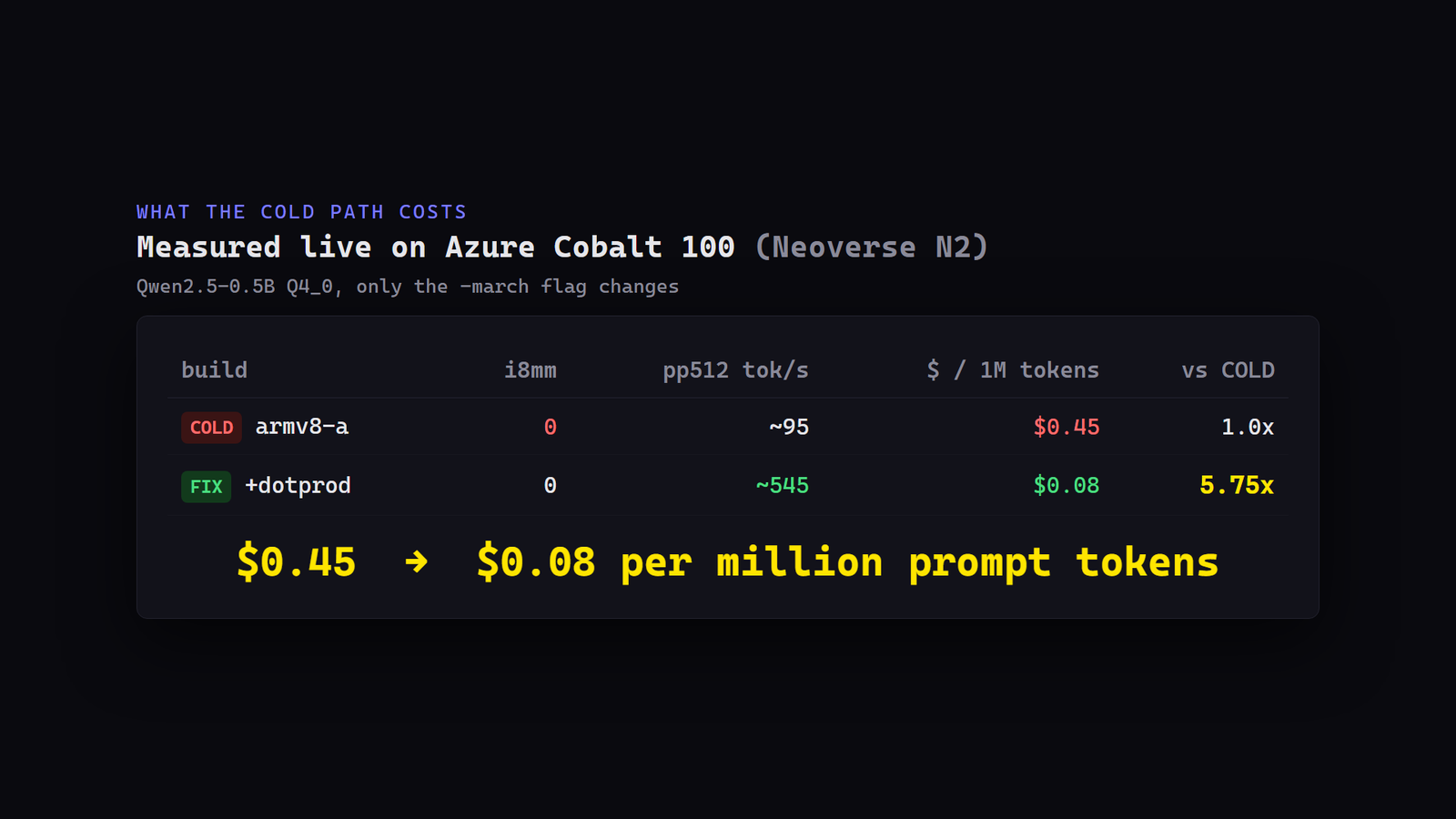
I could not answer a basic question about my own Arm machine: when a local LLM runs, is it actually using the chip's matrix hardware, or silently falling back to scalar code? So I wrote the tool that answers it, pointed it at the ecosystem, and found the most popular Windows-on-Arm LLM runner cold. coldpath is a Capstone-based AArch64 disassembler that proves a binary contains SME, i8mm, and dotprod instructions; the finding is Ollama's official win-arm64 build has zero of any of them. One-line fix filed upstream (PR #17654), 5.75x recovered on prompt processing measured live on Azure Cobalt 100, gated in CI as a reusable GitHub Action.